Courage in Motion
Matangini Hazra
1869 — 1942
A freedom fighter from rural Medinipur whose final march became one of the enduring symbols of courage in India’s struggle for independence. She was in her seventies, widowed, unschooled and poor — and she walked at the front of the procession.
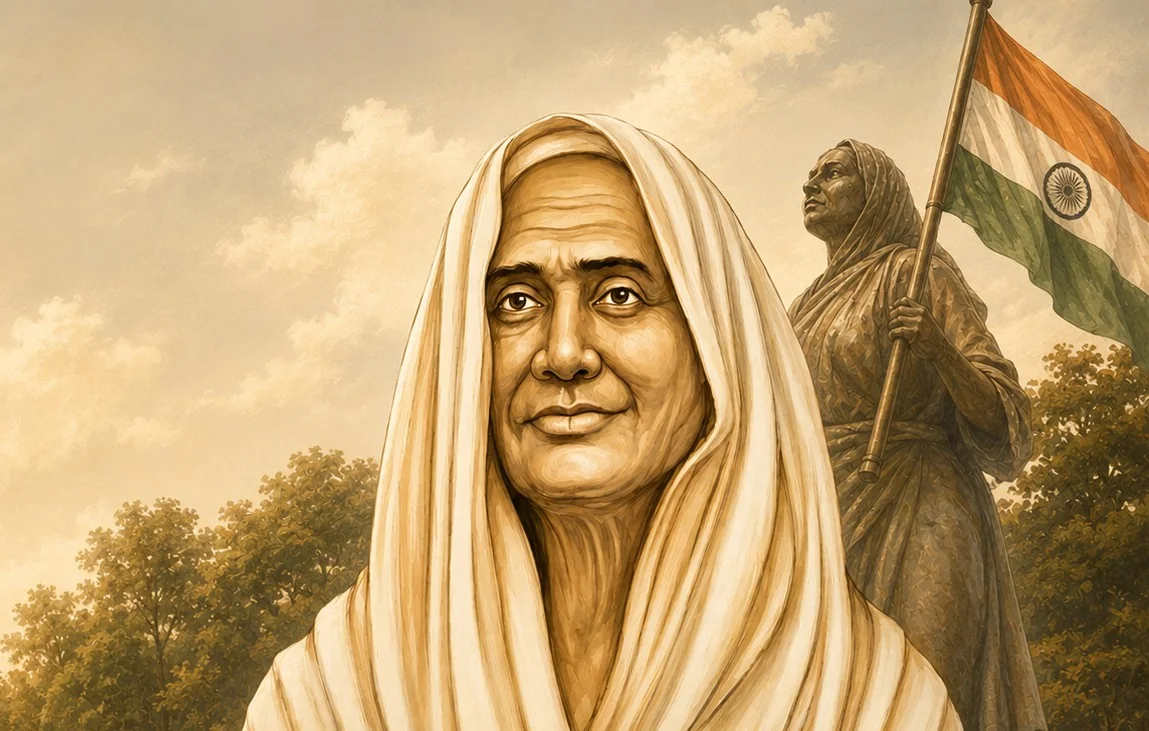
near Tamluk
Disobedience Movement
Baharampur jail
at Tamluk
raised in Kolkata
More than a biography
She is remembered for one morning.
She lived a whole life.
Most accounts of Matangini Hazra begin and end on 29 September 1942. That morning matters — but reading her life backwards from it flattens everything that made her walk at the front of that procession in the first place.
A woman of rural Bengal
Born into a poor peasant family at Hogla, a village of the Tamluk countryside. She had no formal schooling and no property of her own.
Married as a child, widowed at eighteen
Widowed young and childless, she returned to her own village — a social position that, in her time and place, usually meant a life lived at the margins.
A neighbour before she was a nationalist
Accounts from her district describe her caring for the sick during an outbreak of smallpox and helping the households around her, years before any political meeting.
A follower of Gandhian methods
She spun khadi, made salt in defiance of the Salt Act and joined non-violent processions. Her neighbours called her Gandhi Buri — the old lady Gandhi.
A prisoner of the colonial state
Arrested for breaking the salt law, and later sentenced to six months at Baharampur jail for protesting the chowkidari tax. She returned to organising after her release.
A participant, not a symbol
She held no office and led no party. She belonged to the enormous body of ordinary people without whom the independence movement would have remained a movement of leaders only.
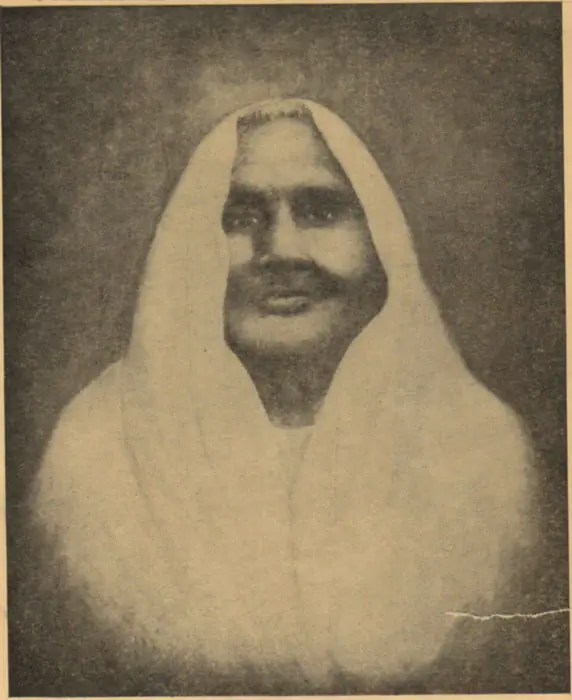
From rural life to a national movement
A life shaped by a countryside the empire governed from a distance
The Medinipur of Matangini Hazra’s lifetime was a district of rice fields, rivers and market towns, administered through a thin layer of colonial officials and a much denser layer of local intermediaries — landholders, revenue collectors, and the village watchman whose upkeep was funded by the chowkidari tax.
For a woman in that society, the possibilities were narrow and narrowed further by widowhood. Early marriage was common. Formal education for village girls was rare. A widow’s life was expected to be austere, dependent and quiet.
What changed was not her circumstances but the political world around her. Through the 1920s and 1930s the nationalist movement stopped being something that happened in Calcutta and started arriving in villages like Hogla — through the Congress organisation, through the spinning wheel, through processions that anyone could join.
Her story is only legible against that background. She did not step out of an ordinary life into an extraordinary one. The movement came to where she already stood, and she answered it.
A path into the movement
Not a sudden decision. A road walked in stages.
Her political life is often compressed into a single day. In the documented record it unfolds over more than a decade, one step at a time.
-
Through the 1920s
Political awakening
The Congress organisation extends into the villages of Medinipur. Nationalist ideas reach Hogla through meetings, processions and the spread of khadi rather than through print.
-
Gandhian influence
The spinning wheel and the salt pan
She adopts Gandhian practice directly: spinning her own khadi, and taking part in the Civil Disobedience Movement. Her neighbours begin calling her Gandhi Buri.
-
1932
Breaking the Salt Act
She joins a Civil Disobedience procession and takes part in making salt at Alinan in defiance of the colonial salt monopoly. She is arrested, and released soon afterwards.
-
The chowkidari tax
Arrest and six months in prison
She joins the agitation against the chowkidari tax. This time she is sentenced, and serves six months at Baharampur jail. On release she becomes an active member of the local Congress.
-
1933
Serampore, and a black flag
She attends the subdivisional Congress conference at Serampore and is injured in a police baton charge. Accounts also describe her taking part in a black-flag protest against the Governor of Bengal.
-
Into the 1940s
Grassroots mobilisation
Despite failing eyesight and advancing age she keeps spinning, keeps organising, and remains part of the local nationalist network that would carry the Quit India Movement into Tamluk.
The centrepiece
1942The final march
On 29 September 1942, a procession set out for the police station and administrative buildings at Tamluk. Matangini Hazra walked at its head.
What the Quit India Movement asked of a district
The Congress passed the Quit India resolution on 8 August 1942 and its national leadership was arrested within hours. What followed was not a campaign directed from the top but a wave of local action. In Medinipur, that took a specific form: Congress workers set out to take over police stations, courts and government offices — to remove colonial administration from the district rather than to petition it.
The procession
On the morning of 29 September, a body of roughly six thousand people — a large proportion of them women volunteers — moved toward Tamluk. Matangini Hazra, then in her seventies, was at the front. Similar actions were taken the same day at Mahisadal and Sutahata.
The order to disperse
At the edge of the town the procession was ordered to break up under Section 144 of the Code of Criminal Procedure, the standing colonial instrument for prohibiting assembly. Accounts describe Matangini Hazra stepping out ahead of the crowd and appealing to the police not to fire on it.
The advance
She was shot. The contemporary nationalist newspaper Biplabi reported that she continued to move forward with the tricolour held up, that she was struck again, and that she was wounded in the forehead and in both hands. Accounts agree that she went on calling Vande Mataram, and that she died still holding the flag.
On the details. Sources differ on how many shots were fired and on her exact age. The elements that recur consistently across contemporary and later accounts are these: she was at the front, she was ordered to disperse, she advanced, she was shot, and the flag did not fall to the ground. Where a source is uncertain, this site says so rather than choosing the most dramatic version.
She was not the only one
Nine other people were killed at Tamluk that day, among them two boys aged thirteen and fourteen. Further deaths followed at Mahisadal and Nandigram. Remembering her alone makes her exceptional; remembering her among them shows what the movement in Medinipur actually cost.
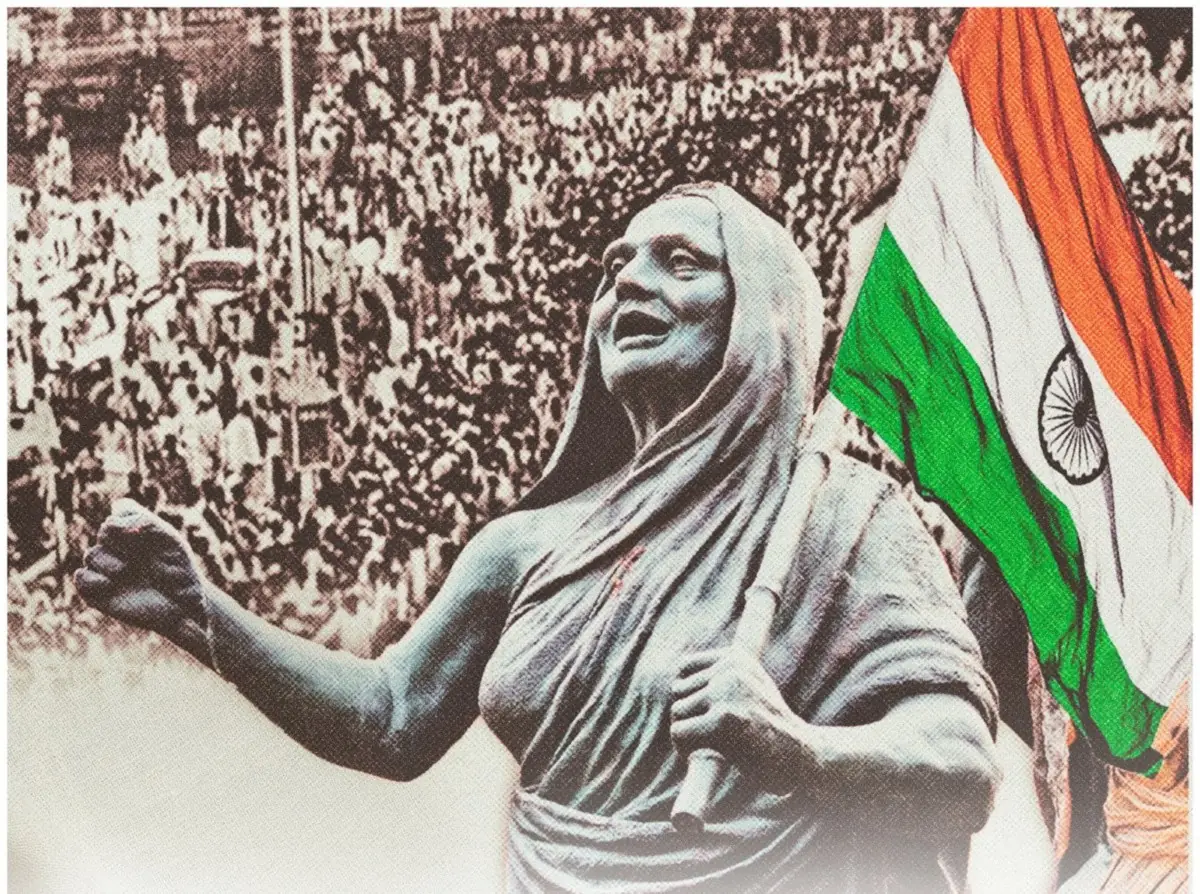
Her body fell.
The idea she stood for did not.
An interpretive statement written for this site. It is not a historical quotation and is not attributed to Matangini Hazra or to any contemporary source. No verified first-person quotations from her are known to survive.
One woman, a larger movement
Women were not an audience to the freedom struggle
They organised it, marched in it, were arrested for it, and died in it — in numbers that most retellings still do not account for.
The Civil Disobedience Movement of 1930–31 marked the point at which Indian women entered nationalist politics on a mass scale. Sarojini Naidu and Kamaladevi Chattopadhyay pressed Gandhi to admit women to the Salt Satyagraha; once he agreed, participation ran far past the small circle of educated urban women who had led the argument. Village women broke the salt law, picketed shops selling foreign cloth and liquor, and went to prison in unprecedented numbers.
In Medinipur during 1942 this took an organised form. A women’s wing, the Bhagini Sena, was raised in the Tamluk region — an organisation of women volunteers with few parallels elsewhere in the country at that moment. The procession Matangini Hazra walked at the head of was made up largely of women.
She belongs in that history, not as its mascot but as one of its participants. The useful question is not how was she so brave? — it is what kind of political organisation put six thousand people, most of them women, on a road to a police station on a Tuesday morning in September?
Explore the journey
Eight chapters, in the order they happened
Each chapter is a full page — the context, the events, and what the record does and does not establish.
Why her story still matters
A question about participation, not about heroism
Treating Matangini Hazra purely as an inspirational figure is the easiest way to learn nothing from her.
Independence was not delivered by a handful of famous names. It was produced by millions of decisions taken by people whose names are not recorded — to join a procession, to refuse a tax, to spin cloth, to go to prison, to keep going after release. Matangini Hazra is visible to us because of how she died. The far larger number of people who made the same choices and survived are not.
That is the useful lesson, and it is a civic one rather than a sentimental one: political change in a democracy is carried by ordinary participation, and the people who carry it are usually not the people it is named after.
Her life also says something specific about who was allowed to participate. She was old, poor, unschooled, widowed and a woman — every category that the society around her treated as a reason to stay out of public life. She did not wait to be given standing. She took a place in the procession.