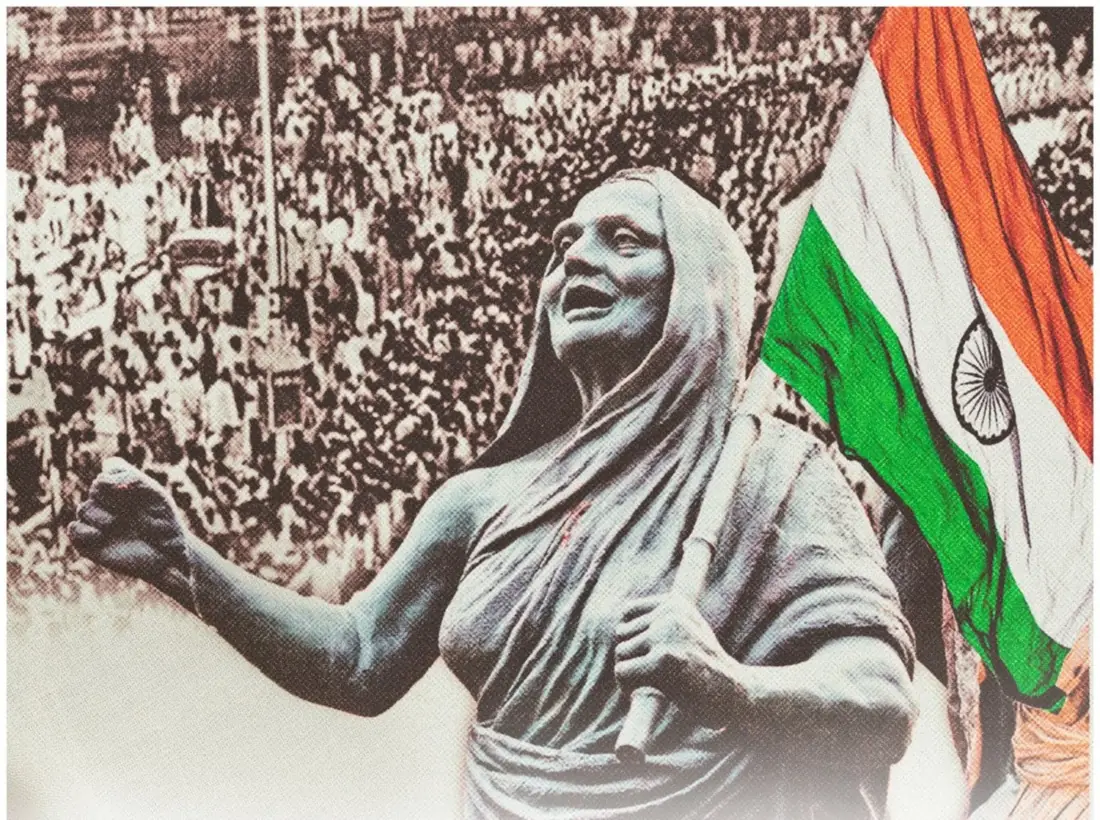
Bengal & the historical context
The country she was born into
Matangini Hazra’s life is only legible against the district and the century that produced it. This page sets out that background — the administration, the economy, the politics, and the place of women in public life.
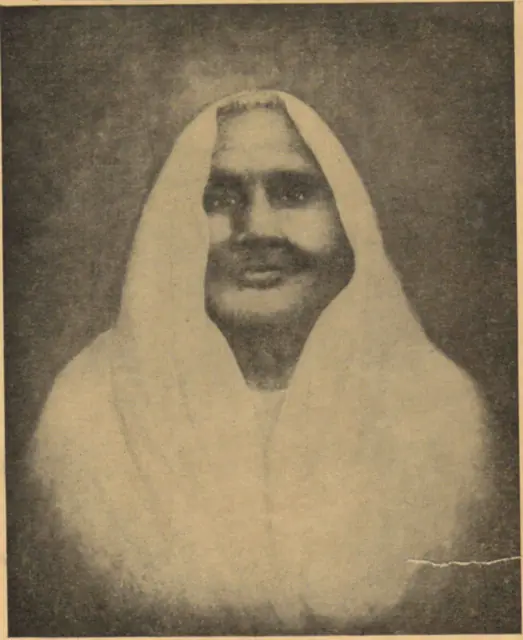
The span of her lifetime
Bengal is governed directly by the Crown, twelve years after the Company’s rule ended. Medinipur is a large, densely settled agricultural district.
The administrative division of the province triggers the Swadeshi movement — the first mass nationalist agitation in Bengal, and the beginning of organised boycott.
Non-cooperation extends nationalist organisation into rural Bengal. Khadi, local committees and processions become the movement’s visible form in the countryside.
Salt satyagraha and no-tax campaigns turn abstract nationalism into specific, local refusals. Matangini Hazra joins in 1932.
With the national leadership imprisoned, Medinipur mounts one of the most far-reaching local risings of the movement.
Section 01
Rural society and the colonial economy
Medinipur was rice country. Most of its people cultivated small holdings, and most of those cultivators belonged to communities like the Mahishyas, to which Matangini Hazra’s family belonged. Land was worked intensively, holdings were small and fragmenting, and the margin between a normal year and a hungry one was thin.
Above the cultivator sat a layered structure of tenure created by the Permanent Settlement of 1793, which fixed the revenue demand on landholders in perpetuity and, over the following century, produced a long chain of intermediaries between the person who worked the land and the government that taxed it. The state’s claim was certain; the cultivator’s security was not.
Colonial administration in the district was thin at the top and dense at the bottom. A small number of British officials governed through a much larger apparatus of Indian subordinates, police, and village-level functionaries — including the chowkidar, the village watchman, whose upkeep was funded by a levy collected locally.
Why the chowkidari tax mattered so much
That levy became one of the most effective targets of rural non-cooperation, and it is worth understanding why. It was small, but it was collected directly from ordinary cultivators; it funded the local policing that villagers experienced as the sharp end of colonial authority; and refusing it required no literacy, no travel and no money — only collective nerve.
It converted a national argument into a local decision. Matangini Hazra’s six-month prison sentence came from exactly this campaign.
Section 02
How nationalism reached a village
Bengal produced organised nationalist politics early. The partition of the province in 1905 provoked the Swadeshi movement, which combined boycott of British goods with the promotion of Indian manufacture, and which drew in students, professionals and landholders across the province. But this was still largely a movement of the towns and the educated.
What changed in the 1920s and 1930s was the method. Under Gandhi’s influence the Congress adopted forms of action that did not require literacy or income to participate in:
- The spinning wheel. Khadi turned a political position into a daily domestic practice that anyone could adopt, including women who could not leave the household.
- The procession. A public act requiring only presence — and one that made the size of support visible.
- The refusal. Not paying a tax, or making salt, converted principle into a concrete, individually punishable act.
- The local committee. Congress organisation at village and subdivisional level meant instructions and news travelled by person rather than by print.
This is the mechanism by which a movement led by lawyers reached a woman who could not read. It is also why Medinipur, when the moment came in 1942, had the organisational depth to act without instructions from anyone.
Section 03
Women, and the limits on public life
For most of Matangini Hazra’s life, a rural Bengali woman’s public presence was tightly bounded. Marriage came early. Formal education for village girls was rare. Widowhood, in particular, carried expectations of withdrawal from ordinary social life.
Reform had touched the law without much touching practice. Widow remarriage had been legalised in 1856; it remained socially unacceptable across most of rural Bengal for decades afterwards. Legal change and social change ran on very different clocks.
The nationalist movement did not set out to dismantle this, but it did something with large consequences: it created a public activity that women could legitimately join. Picketing, spinning, processions and prison were framed as service and sacrifice — categories a conservative society could accept — and through that opening very large numbers of women entered political life for the first time.
By 1942, in the Tamluk region, this had gone further than almost anywhere else in the country: a women’s organisation, the Bhagini Sena, was formed as part of the local movement.
The place itself
Tamluk: an ancient port that became an administrative town
Tamluk stands on the Rupnarayan river in what is now Purba Medinipur. Its older name, Tamralipta, belonged to a port of considerable antiquity, connected by water to the Bay of Bengal and, through it, to maritime trade far beyond Bengal.
By the colonial period the river had shifted and the port had long declined, but the town retained its importance as the administrative centre of the Tamluk subdivision. That is why it mattered in 1942: the police station, the courts and the government offices of the subdivision were concentrated there.
When Medinipur’s Congress workers decided to take over the machinery of administration rather than protest outside it, Tamluk was the obvious target — and the name of the parallel government that followed, Tamralipta Jatiya Sarkar, reached back to the town’s ancient name.