Places of memory & legacy

What was built afterwards

A parallel government, two statues, a stamp and a college. Each entry below is one this site can support from published sources — and the page says plainly where common claims cannot be verified.

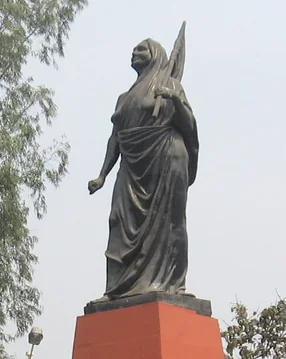
Bronze statue of Matangini Hazra on a red plinth in Kolkata, standing with one arm outstretched and trees behind.
Kolkata, 1977 The statue on the Maidan, reported as the first statue of a woman raised in the city in independent India.

The first legacy

1942
–44

Tamralipta Jatiya Sarkar

The most substantial thing that followed her death was not a monument. It was a government.

On 17 December 1942, less than three months after the Tamluk march, a parallel administration was constituted for the Tamluk and Contai subdivisions of Medinipur. It took its name from Tamralipta, the ancient name of Tamluk.

It was a government in substance, not in gesture:

  • Leadership. Satish Chandra Samanta served as Sarbadhinayak — supreme head — until his arrest in 1943. Sushil Kumar Dhara and Ajoy Mukherjee were among its principal figures.
  • Departments. It maintained arrangements for justice, finance, education and defence, ran its own courts, and operated a postal system.
  • An armed wing. The Bidyut Bahini, the Lightning Force, under Sushil Kumar Dhara.
  • Relief. After the cyclone of 16 October 1942, when the colonial administration’s response was minimal, it organised relief for the affected population.

It functioned for roughly twenty months and was wound up on 8 August 1944 at Gandhi’s request. It is the longest-running parallel government of the Quit India period.

This is the most accurate account of what her death led to. Not a change of policy, and not independence — that was five years away. A district governed itself for nearly two years.

Documented commemoration

Where her memory is held

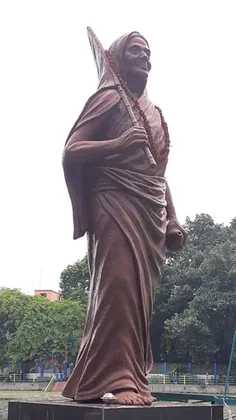
A tall terracotta-coloured statue of Matangini Hazra striding forward with a flagstaff over her shoulder, garlanded with marigolds.
Tamluk, Purba Medinipur, West Bengal

The memorial at Tamluk

A statue stands at Tamluk near the place where she was killed. It shows her in motion — mid stride, the flagstaff carried over her shoulder — rather than standing at rest or fallen.

It is a defensible interpretive choice. Whatever else the sources disagree on, every account of 29 September 1942 has her moving forward.
Maidan, Kolkata, West Bengal

The statue in Kolkata, 1977

A statue of Matangini Hazra was erected in Kolkata in 1977, on the Maidan. It is widely reported as the first statue of a woman raised in the city in independent India — a claim about the city, and one worth stating with that qualification rather than as a national first.

The figure stands on a red plinth, one arm extended. Thirty-five years separate the event from the memorial, which is itself part of the history: commemoration followed a long interval in which the district’s rising was not much discussed nationally.

Bronze statue of Matangini Hazra on a red plinth in Kolkata, with trees and open sky behind.
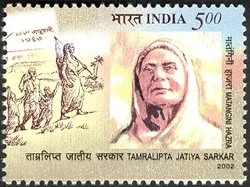
Indian postage stamp of 2002, value five rupees, showing a portrait of Matangini Hazra and an illustration of the Tamluk procession.
India Post, 2002 · ₹5

The commemorative stamp

In 2002 the Indian postal department issued a five-rupee stamp bearing her image, marking sixty years of the Quit India Movement and of the Tamralipta Jatiya Sarkar.

The design is precise about what it commemorates: her portrait sits beside a depiction of the procession, under the name of the parallel government. It marks a collective act of self-government rather than an individual martyrdom.

Tamluk, Purba Medinipur, West Bengal

Shahid Matangini Hazra Government General Degree College for Women

A government degree college for women at Tamluk carries her name. Of all the forms commemoration has taken, this is arguably the one most closely matched to the facts of her life: an institution providing to women of her own district the education she herself never had any access to.

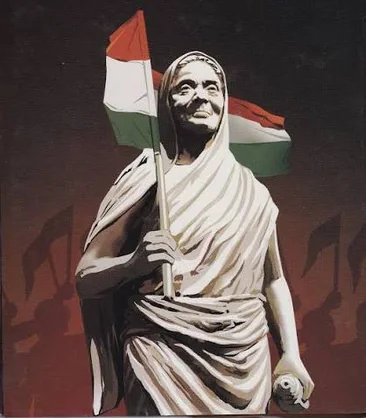
Painted image of the memorial statue of Matangini Hazra holding the Indian tricolour against a dark red background.

Verification

Claims this site does not make

A great deal is repeated about Matangini Hazra that cannot be traced to a reliable source. Rather than pass it on, this page lists it.

  • No quotationsNo verified first-person quotation from Matangini Hazra is known to survive — no speech, letter, or recorded conversation. Dialogue attributed to her in popular retellings is not evidenced. The invocation Vande Mataram is reported by accounts as what she was calling, not as a quoted statement.
  • No meeting with GandhiHer name, Gandhi Buri, reflects her adoption of Gandhian practice. There is no evidence that she ever met him, and this site does not suggest otherwise.
  • Roads and public placesVarious roads, schools and localities in West Bengal are commonly said to be named after her. Some of these attributions are repeated widely without a documented basis. Where this site cannot verify a specific naming, it does not list it.
  • Exact casualty figuresNumbers for those killed at Tamluk, Mahisadal and Nandigram in late September 1942 vary between accounts and were disputed at the time. Figures given on this site follow published histories of the district and should be read as the best available record.
  • Her ageReported as 71, 72 or 73 in September 1942, depending on whether a source follows an 1869 or 1870 birth year. This site says “in her seventies” where precision is not available.

The risk in remembering her well

Statues are a particular kind of memory. They fix a person at one instant, usually the instant of their death, and they remove everything that led to it. Rendered only as a bronze figure with a flag, Matangini Hazra becomes an emblem — and an emblem cannot teach anything, because it never had to decide anything.

The version of her worth keeping is the one that includes the forty-five undocumented years, the smallpox nursing, the first procession at sixty-two, the arrest, the six months in Baharampur, the baton charge, and the decision to go back afterwards — repeatedly.

That version is harder to cast in bronze and much more useful to learn from.

Learn & educational resources

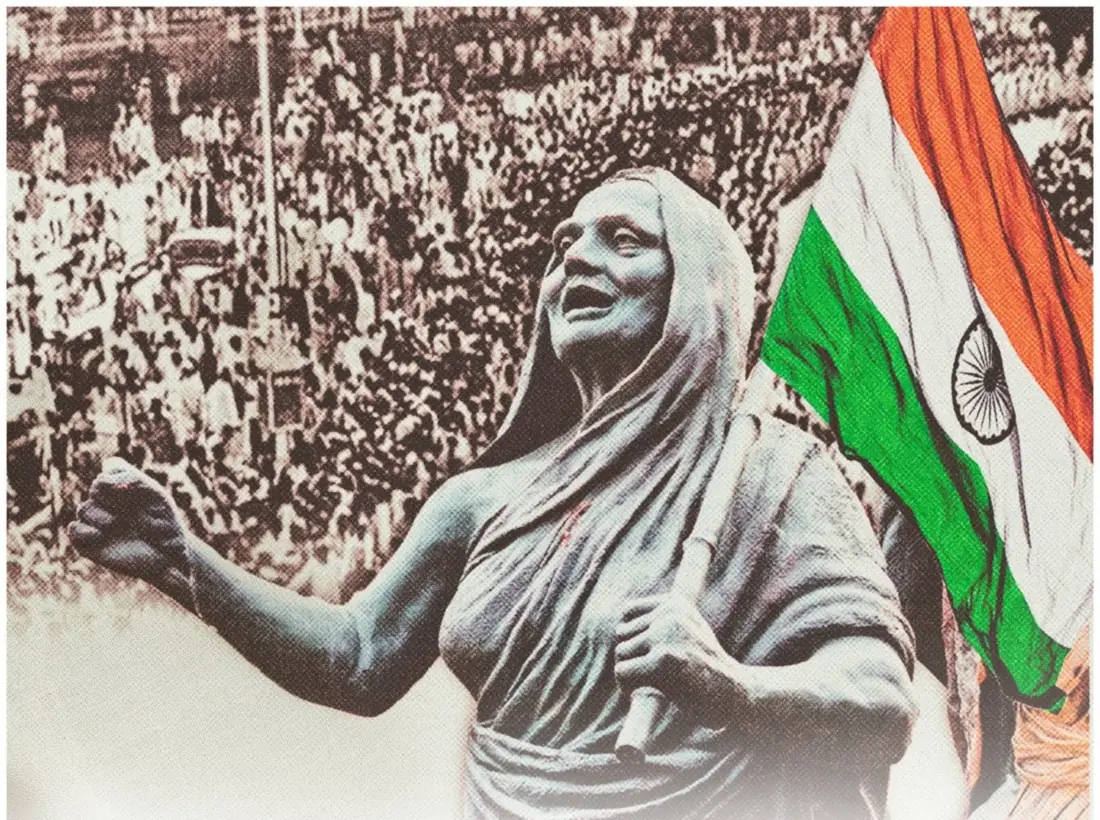
A memorial statue of Matangini Hazra with the Indian national flag beside her, set against an archival photograph of a very large crowd.
Figure and crowd Commemoration tends to keep the figure and lose the crowd. Both are needed to read the history accurately.