A journey into the movement

How a movement of leaders became a movement of everyone

The independence struggle is usually narrated through a handful of national figures. Matangini Hazra’s political life shows the other half of the machine — the part without which none of it worked.

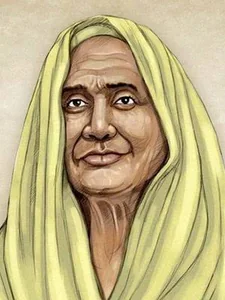
Illustrated portrait of Matangini Hazra as an elderly woman with a pale green sari drawn over her head.
Gandhi Buri The name her neighbours gave her — the old lady Gandhi — describes a practice rather than a rank.

Six stages

A political life, in the order it happened

Each stage below is documented in published accounts of the movement in Medinipur. Where a date or a detail is uncertain, it is marked as such rather than smoothed over.

Political awakening

Nationalist politics reached Hogla the way it reached most Bengali villages — not through newspapers but through people. Congress organisation extended down to subdivisional and village level during the 1920s, and with it came meetings, processions, and the visible everyday symbol of khadi.

For a woman who could not read, this was the only way in. The movement had to arrive in person, and it did.

Why the method mattered. Gandhian technique was not only a moral choice. It was a recruitment strategy: it made participation possible for people with no literacy, no money and no leisure.
Gandhi and mass participation

She adopted Gandhian practice directly and without qualification: she spun her own khadi, joined non-violent processions, and treated the discipline of non-violence as binding. Her neighbours began calling her Gandhi Buri. Accounts note that she continued spinning even as her eyesight failed and her age advanced.

There is no evidence that she ever met Gandhi, and this site makes no such claim. Her connection to him was through method, not acquaintance.

Civil disobedience: salt

In 1932, in her early sixties, she joined a Civil Disobedience procession — her first documented political act. She took part in the manufacture of salt at Alinan in deliberate breach of the colonial salt monopoly, one of the most widely repeated acts of the movement across India.

She was arrested for it, and released shortly afterwards. The arrest did not deter her; it was the beginning of a decade of participation.

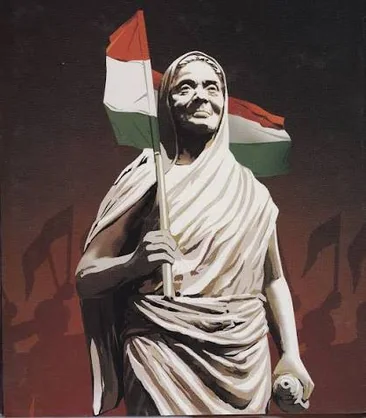
A painted image of the memorial statue of Matangini Hazra holding the Indian tricolour, against a dark red background with silhouetted flags.
The flagMemorial imagery consistently places the national flag in her hands.

Local protest: the chowkidari tax

She then joined the campaign against the chowkidari tax — the levy that funded the village watchman. Accounts describe her marching toward the court building as part of the protest against what the movement regarded as an illegitimate court.

This is the campaign that turned an abstract national demand into a specific local refusal, and it is the one that cost her most directly.

Arrest and imprisonment

For the chowkidari tax protest she was sentenced to six months’ imprisonment at Baharampur jail — a substantial term for a woman then in her sixties, served far from her own subdivision.

The significant fact is what happened afterwards. On release she did not withdraw. She became an active member of the local Congress organisation and returned to public activity. In 1933 she attended the subdivisional Congress conference at Serampore, where she was injured in a police baton charge; accounts also place her in a black-flag protest against the Governor of Bengal, Sir John Anderson.

Grassroots mobilisation

Through the later 1930s and into the 1940s she remained part of the local nationalist network in the Tamluk region — the dense, unglamorous organisational fabric of committees, volunteers and personal contacts.

That fabric is what allowed Medinipur to act coherently in September 1942 at a moment when the Congress high command was in prison and no instructions were coming from anywhere.

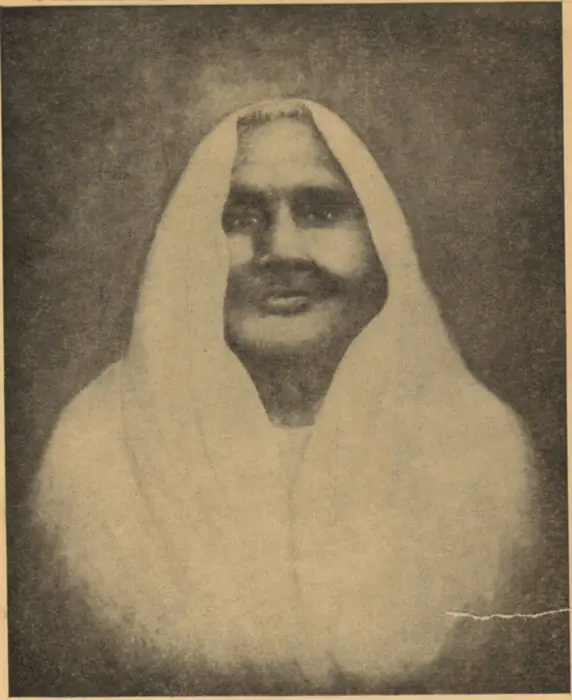
Archival photograph of Matangini Hazra in later life, her white sari drawn over her head.
In later lifeShe was in her seventies through the final phase of her political activity.

The point of this chapter

The movement was not made of leaders

It was made of people who joined, refused, marched, went to prison, came out, and joined again — usually more than once.

A history told only through Gandhi, Nehru, Bose and Patel explains the decisions but not the outcome. Decisions taken in Bombay or Delhi became consequential only because hundreds of thousands of people in places like Hogla were prepared to act on them at personal cost — and, in 1942, to act without them.

Matangini Hazra is a useful figure precisely because she is so ordinary in her resources and so unremarkable in her rank. She had nothing that would have marked her out in advance. What she had was the willingness to keep showing up — after arrest, after imprisonment, after a baton charge, and into her seventies.

That is the thing the record actually establishes about her, and it is more instructive than any dramatised version of her death.