Learn & educational resources
History you can actually use
For students, teachers and general readers. Plain explanations, a glossary, discussion questions, and an honest account of where popular retellings depart from the record.
Questions
The essentials
Eight questions covering the person, the movement and the events. Select any question to open the answer.
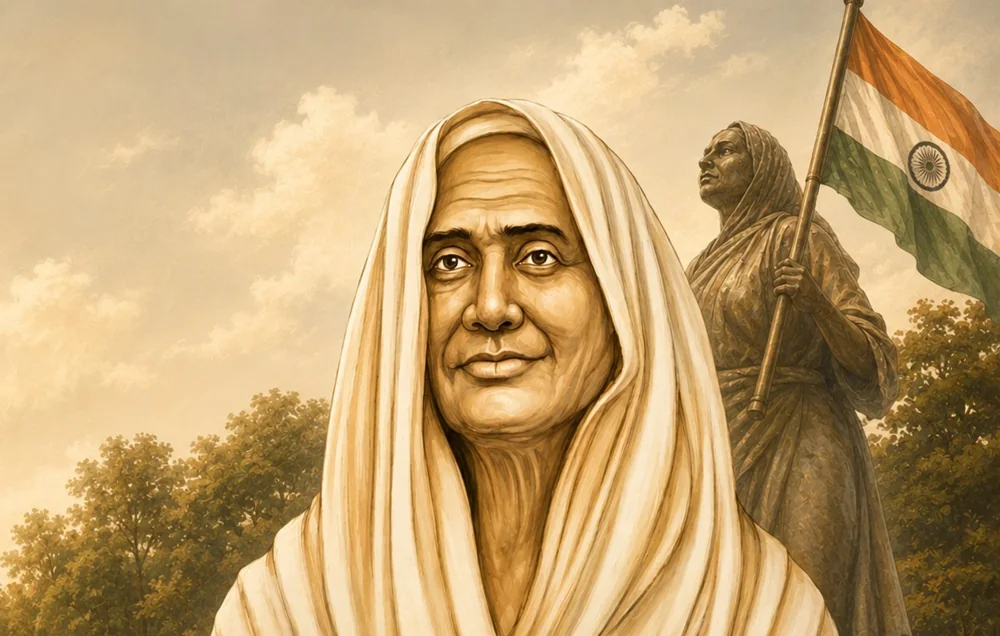
Matangini Hazra (1869–1942) was an Indian freedom fighter from Hogla village in the Medinipur district of Bengal. Born into a poor peasant family, married as a child and widowed at eighteen, she had no formal education. She joined the Civil Disobedience Movement in 1932, was imprisoned for six months for protesting the chowkidari tax, and was shot by colonial police on 29 September 1942 while leading a Quit India procession at Tamluk. Her neighbours called her Gandhi Buri — the old lady Gandhi.
The Indian independence movement was the long campaign to end British rule in India. It ran from the nineteenth century to independence in 1947, and it took many forms — constitutional argument, mass non-violent non-cooperation, revolutionary activity, labour and peasant organisation.
From about 1920 the Indian National Congress, under Gandhi’s influence, made mass participation its central method. That decision is what brought people like Matangini Hazra into political life: it created ways of taking part that did not require education, money or social standing.
Civil disobedience means deliberately breaking a specific law you consider unjust, openly and without violence, and accepting the punishment. It is different from ordinary protest in three ways: the act is illegal by design, it is done publicly rather than in secret, and the penalty is invited rather than avoided.
In India this meant making salt in defiance of the government monopoly, refusing to pay particular taxes, picketing shops selling imported cloth and liquor, and assembling in defiance of prohibitory orders. Matangini Hazra did the first, the second and the fourth of these.
On 8 August 1942 the All India Congress Committee passed a resolution demanding an immediate end to British rule — the Quit India resolution. Within hours, in the early morning of 9 August, the British administration arrested Gandhi, Nehru, Patel, Azad and effectively the entire Congress leadership, and banned the organisation.
Because there was no leadership left to direct the campaign, what followed was decided locally, district by district. Some districts saw little; a few, including Medinipur in Bengal, saw sustained risings in which people attempted to remove colonial administration altogether.
Medinipur had unusually deep nationalist organisation reaching down to village level, and a population with direct experience of earlier salt and no-tax campaigns. When the national leadership was imprisoned, the district already had the structures needed to act on its own.
On 29 September 1942 there were coordinated actions against the police stations at Tamluk, Mahisadal and Sutahata. Matangini Hazra was killed during the action at Tamluk. In December 1942 the district established the Tamralipta Jatiya Sarkar, a parallel government that ran for roughly twenty months.
A procession of around six thousand people, a large proportion of them women volunteers, moved toward the police station and government offices at Tamluk, intending to take possession of them and raise the national flag. Matangini Hazra, then in her seventies, was at its head.
At the edge of the town the police ordered the procession to disperse under Section 144 of the Code of Criminal Procedure. Accounts describe her stepping forward and appealing to the police not to fire on the crowd. She was shot, continued to advance holding the flag, was struck again, and died still holding it while calling Vande Mataram. Nine other people were killed at Tamluk that day, including two boys aged thirteen and fourteen.
A very large one, and larger than most textbooks record. From the Civil Disobedience Movement of 1930 onwards, Indian women took part on a mass scale: breaking the salt law, picketing shops, spinning khadi, refusing taxes, marching in processions, and going to prison in unprecedented numbers.
In the Tamluk region in 1942 this went further than in most places, with the formation of a women’s wing, the Bhagini Sena. The procession Matangini Hazra led was made up largely of women.
A parallel government constituted on 17 December 1942 for the Tamluk and Contai subdivisions of Medinipur, named after Tamralipta, the ancient name of Tamluk. Satish Chandra Samanta was its head; Sushil Kumar Dhara commanded its armed wing, the Bidyut Bahini.
It ran courts, collected revenue, maintained order, operated a postal arrangement, and organised relief after the cyclone of 16 October 1942. It was wound up on 8 August 1944 at Gandhi’s request, and is the longest-running parallel government of the Quit India period.
Historical fact vs popular retelling
What gets added when a story is retold
This is the most useful thing on the page, and the most transferable: a worked example of how a documented event acquires details that were never in the record.
“She said her famous last words as she fell.”
Retellings frequently supply her with a final speech or a defiant sentence addressed to the police.
No verified quotation from her survives
Accounts report that she was calling Vande Mataram. There is no recorded speech, letter or transcribed statement. Any specific sentence attributed to her has been added later.
“She was a close follower of Gandhi.”
The nickname Gandhi Buri is often read as implying a personal connection.
She followed his methods, not the man
She adopted Gandhian practice — khadi, salt, non-violent protest — and was named for it by her neighbours. There is no evidence she ever met him.
“She was 73 years old.”
A specific age is usually stated with confidence.
71, 72 or 73 — sources disagree
Her birth year is given as either 1869 or 1870. Until that is settled, her exact age in September 1942 cannot be stated. “In her seventies” is accurate.
“She died alone, a lone heroine.”
The narrative usually isolates her as a single exceptional figure.
Nine others were killed at Tamluk that day
Including two boys aged thirteen and fourteen, with further deaths at Mahisadal and Nandigram. She walked at the head of roughly six thousand people.
A method you can reuse. When you meet a historical claim, ask three questions. Who recorded this, and when? Could they have known it? Does the detail make the story better — and if so, is that why it is there? Details that add drama and have no traceable source usually arrived after the fact.
Key terms
Glossary
- Satyagraha
- Gandhi’s term for non-violent resistance — literally, holding firmly to truth. It combined refusal to cooperate with an unjust authority with a refusal to use violence against it.
- Civil disobedience
- Deliberately breaking a specific law considered unjust, openly and non-violently, and accepting the legal penalty.
- Khadi
- Hand-spun, hand-woven cloth. Promoted as a protest against imported textiles, a source of rural income, and a daily practical expression of self-reliance.
- Salt Satyagraha
- The 1930 campaign against the government monopoly on salt, opened by Gandhi’s march to Dandi and repeated across India. Matangini Hazra took part in salt-making at Alinan in 1932.
- Chowkidari tax
- A local levy funding the village watchman (chowkidar). Because it was paid directly by ordinary cultivators, refusing it became an effective form of rural non-cooperation.
- Section 144 (CrPC)
- A provision of the Code of Criminal Procedure allowing a magistrate to prohibit assembly in a specified area. It is frequently misdescribed as part of the Indian Penal Code; it is not.
- Quit India Movement
- The campaign launched by the Congress resolution of 8 August 1942 demanding an immediate British withdrawal, and the local risings that followed the arrest of the leadership.
- Gandhi Buri
- Bengali for “the old lady Gandhi” — the name Matangini Hazra’s neighbours gave her, describing her adoption of Gandhian practice.
- Vande Mataram
- A song from Bankim Chandra Chattopadhyay’s novel Anandamath, adopted as a nationalist invocation. Accounts record Matangini Hazra calling it as she advanced.
- Tamralipta Jatiya Sarkar
- The Tamluk National Government, a parallel administration for the Tamluk and Contai subdivisions, 17 December 1942 to 8 August 1944.
- Bidyut Bahini
- The “Lightning Force”, the armed wing of the Tamralipta Jatiya Sarkar, commanded by Sushil Kumar Dhara.
- Bhagini Sena
- The women’s wing organised in the Tamluk region during the 1942 movement.
- Mahishya
- A community forming the majority of the cultivating population of Medinipur district, to which Matangini Hazra’s family belonged.
- Parallel government
- An administration set up by a movement to replace the existing state in a territory it controls — running courts, revenue and policing rather than merely protesting.
For the classroom
Timeline activities
Three exercises built on the material on this site. Each produces something a student can show, and each teaches a habit rather than a fact.
Build the two timelines
Make one timeline of Matangini Hazra’s life and a second of national events between 1869 and 1944. Place them side by side. Mark every point where the national line changes what happens on the personal one — and every point where it does not.
Find the gap
Identify the years in her life for which we have almost no information. Write a paragraph explaining why those years are missing from the record. This teaches that archives are shaped by who had property, office and literacy.
Compare three accounts
Find three published accounts of 29 September 1942. List every point on which they differ — her age, the number of shots, the size of the crowd. Then decide which differences matter to the history and which do not.
Name the unnamed
Nine other people were killed at Tamluk that day. Research what can be established about them. Write about what the difference in how they are remembered tells us about how public memory works.
Discussion
Questions worth arguing about
None of these has a single correct answer. They are designed for discussion rather than for recall.
- Matangini Hazra joined her first procession in her sixties. What does that suggest about who is able to take political risks, and when in a life?
- The movement created forms of action — spinning, picketing, refusing a tax — that people with no education or money could join. How much of the movement’s success do you think depended on that design choice?
- Is it more useful to remember her as an exceptional individual, or as one of thousands of participants? What does each version teach, and what does each hide?
- Section 144 made the procession illegal before it set out. What does it mean for a government to be able to define assembly itself as an offence?
- The Tamralipta Jatiya Sarkar governed a region for twenty months. Was it a government? What would you require of it before saying yes?
- Nine other people died at Tamluk that day, two of them children. Why do you think her name survived and theirs largely did not?
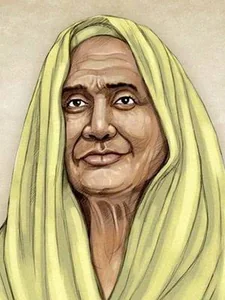
- Most images of Matangini Hazra were made after her death, by artists who never saw her. How should we treat such images as historical evidence?
- This site repeatedly says “sources disagree” rather than giving one figure. Does that make the history more useful or less? Who is it more useful for?
For younger readers
Her story, in six sentences
Matangini Hazra was born in a small village in Bengal in 1869, into a family that farmed a little land and had very little money. She was married when she was still a child, and by the time she was eighteen her husband had died and she was living on her own. For many years she looked after the people around her — including nursing them through a dangerous illness that made others stay away.
When she was in her sixties, India’s movement for independence reached her village, and she joined it. She made salt when the law said she could not, refused to pay a tax she thought was unfair, and spent six months in prison for it — and when she came out, she carried on.
In 1942, when she was in her seventies, she walked at the front of a very large march to take over a government building at Tamluk, carrying the Indian flag. The police told the march to stop, and then fired. She kept walking forward with the flag, and she was killed.
People remember her because she kept going — not just on that one day, but for the ten years before it.
A note for teachers and parents. This page describes her death plainly but without graphic detail, and it avoids dramatised dialogue. If a younger reader asks what happened, the honest and sufficient answer is that she was shot by the police while taking part in a protest, and that she did not stop walking.
Going further
Where this material comes from
- Contemporary nationalist pressThe paper Biplabi, published in the district during the 1942 movement, is the source most often cited for the detail of the events of 29 September 1942.
- District histories of MedinipurPublished accounts of the Quit India Movement in Medinipur cover the preparation, the actions at Tamluk, Mahisadal and Sutahata, the repression that followed, and the Tamralipta Jatiya Sarkar.
- Histories of women in the Indian national movementScholarship on women’s participation from the Salt Satyagraha onward provides the context for the scale and forms of that participation.
- Institutional and commemorative recordsDetails of the 1977 statue, the 2002 commemorative stamp and the college at Tamluk come from institutional and postal records.
- A cautionA great deal of online material about Matangini Hazra repeats invented quotations and unverifiable detail. Where this site could not establish a claim, it either omits it or states that it is unverified.