Timeline
1869 — 1942,
and afterwards
Seventeen milestones. Select any one to open it. Dates that sources disagree on are marked as approximate rather than presented as settled.
Jump to a period
Milestones
-
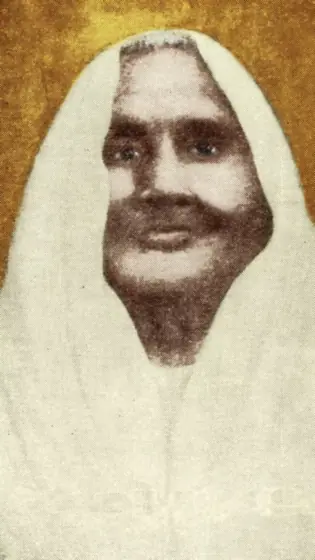
Matangini Hazra is born at Hogla, a village in the Tamluk subdivision of Medinipur district, Bengal Presidency. Her father, Thakurdas Maity, is a poor peasant; the family belongs to the Mahishya community. She receives no formal education and never learns to read or write.
Note: published sources give the year as either 1869 or 1870. The day, 19 October, appears consistently. This disagreement is the reason her age at death is variously reported as 71, 72 or 73.
-
She is married at about the age of twelve to Trilochan Hazra of Alinan, a man considerably older than she is and already widowed. Child marriage and large age gaps are ordinary in rural Bengal at this date.
-
She is widowed at eighteen, without children, and returns to Hogla to live independently. In the society of the time this is among the most constrained positions available to a woman: no claim on her husband’s household, no income, and an expectation of withdrawal from public life.
-
Almost nothing about these years is documented. Later local accounts describe her supporting herself by her own labour, helping the households around her, and nursing the sick during an outbreak of smallpox in the area.
The silence is typical rather than exceptional: poor rural women in colonial India generated almost no documents, and so appear almost nowhere in the archive.
-
The partition of Bengal triggers the Swadeshi movement, the province’s first mass nationalist agitation. Over the following two decades, and particularly during the non-cooperation movement of the 1920s, Congress organisation extends from the towns into rural Bengal — arriving in villages as meetings, processions and khadi rather than as print.
-
In her early sixties, she joins a Civil Disobedience procession — her first documented political act. She takes part in the manufacture of salt at Alinan in open breach of the colonial salt monopoly, and is arrested. She is released shortly afterwards.
Accounts also associate her participation with a procession on 26 January, the date adopted by the Congress as Independence Day.
-
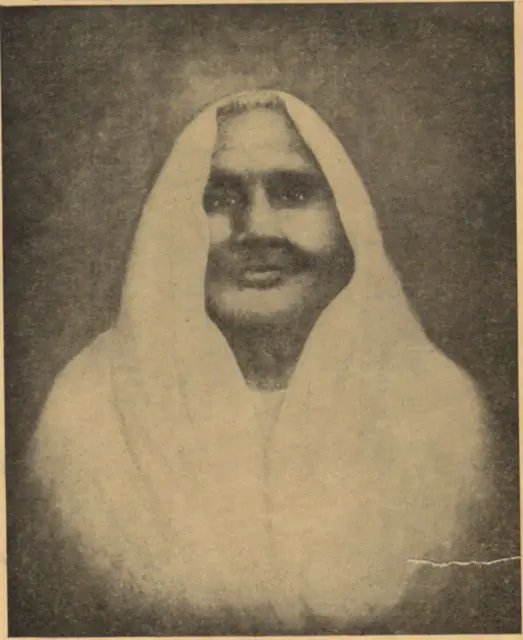
She joins the agitation against the chowkidari tax, the levy funding the village watchman, taking part in a march toward the court building. This time she is sentenced, and serves six months at Baharampur jail in Murshidabad district.
On release she becomes an active member of the local Congress organisation and resumes public activity, spinning her own khadi as her eyesight fails.
-
She attends the subdivisional Congress conference at Serampore, which is broken up by police, and is injured in the baton charge. Accounts from the district also place her in a black-flag demonstration against Sir John Anderson, Governor of Bengal.
-
On 8 August the All India Congress Committee passes the Quit India resolution in Bombay, demanding an immediate end to British rule. In the early hours of 9 August the administration arrests Gandhi, Nehru, Patel, Azad and effectively the entire Congress leadership. The organisation is banned.
With no leadership left to issue instructions, the movement devolves to the districts.
-
Volunteer batches have been organised across the subdivision, with training in drill and in attending to casualties under Sushil Kumar Dhara. During the night the main link roads are cut at several points and communication lines severed, to slow the arrival of reinforcements.
Actions are set for the following morning at Tamluk, Mahisadal and Sutahata.
-
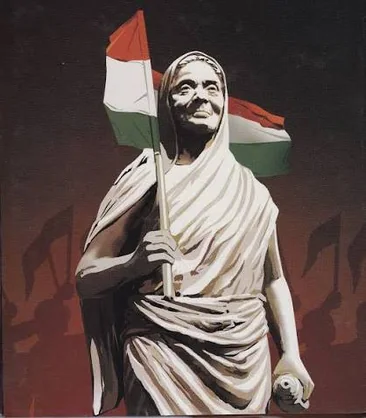
A procession of roughly six thousand people, a large proportion of them women volunteers, moves toward the police station and administrative buildings at Tamluk with the objective of taking possession and raising the national flag. Matangini Hazra, in her seventies, is at its head.
At the outskirts of the town the procession is ordered to disperse under Section 144 of the Code of Criminal Procedure. Accounts describe her stepping forward and appealing to the police not to fire on the crowd. She is shot.
The contemporary paper Biplabi reports that she continued to advance with the tricolour, was struck again, and was wounded in the forehead and both hands. Accounts agree that she went on calling Vande Mataram, and died still holding the flag. Nine others are killed at Tamluk that day, including two boys aged thirteen and fourteen.
-
A severe cyclone strikes the coastal Medinipur region, causing heavy loss of life and destroying the standing crop. Relief from the colonial administration is minimal; local Congress workers organise relief themselves. The following year brings the Bengal famine of 1943.
-
A parallel government is constituted for the Tamluk and Contai subdivisions, with Satish Chandra Samanta as its head and an armed wing, the Bidyut Bahini, under Sushil Kumar Dhara. It runs courts, collects revenue, maintains order, operates a postal arrangement and organises cyclone relief.
-
The Tamralipta Jatiya Sarkar is dissolved at Gandhi’s request, after roughly twenty months of operation. It remains the longest-running parallel government of the Quit India period.
-
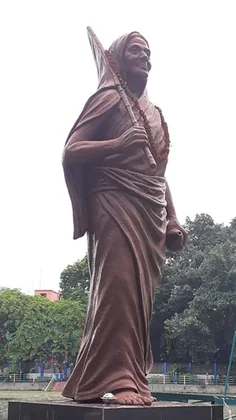
A statue of Matangini Hazra is erected in Kolkata, on the Maidan. It is reported as the first statue of a woman put up in the city in independent India. A memorial also stands at Tamluk, near the place where she was killed.
-
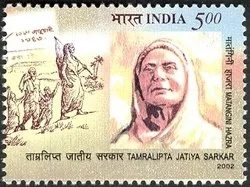
The Indian postal department issues a five-rupee stamp bearing her image, marking sixty years of the Quit India Movement and of the Tamralipta Jatiya Sarkar.
-
A government degree college for women at Tamluk carries her name. Roads, schools and public places in West Bengal are also associated with her memory.
Some attributions repeated in popular sources are not firmly documented; this site lists only those it can support, and says so where it cannot.
How to read this timeline. Entries marked “around” or with c. are approximate, derived from her stated age at an event rather than from a recorded date. Where published sources disagree — on her birth year, on her age in 1942, on the number of shots fired — the disagreement is stated rather than resolved.